Tower Server vs Rack Server in India (2026): Which Should You Buy?
By Rohit, Founder ·
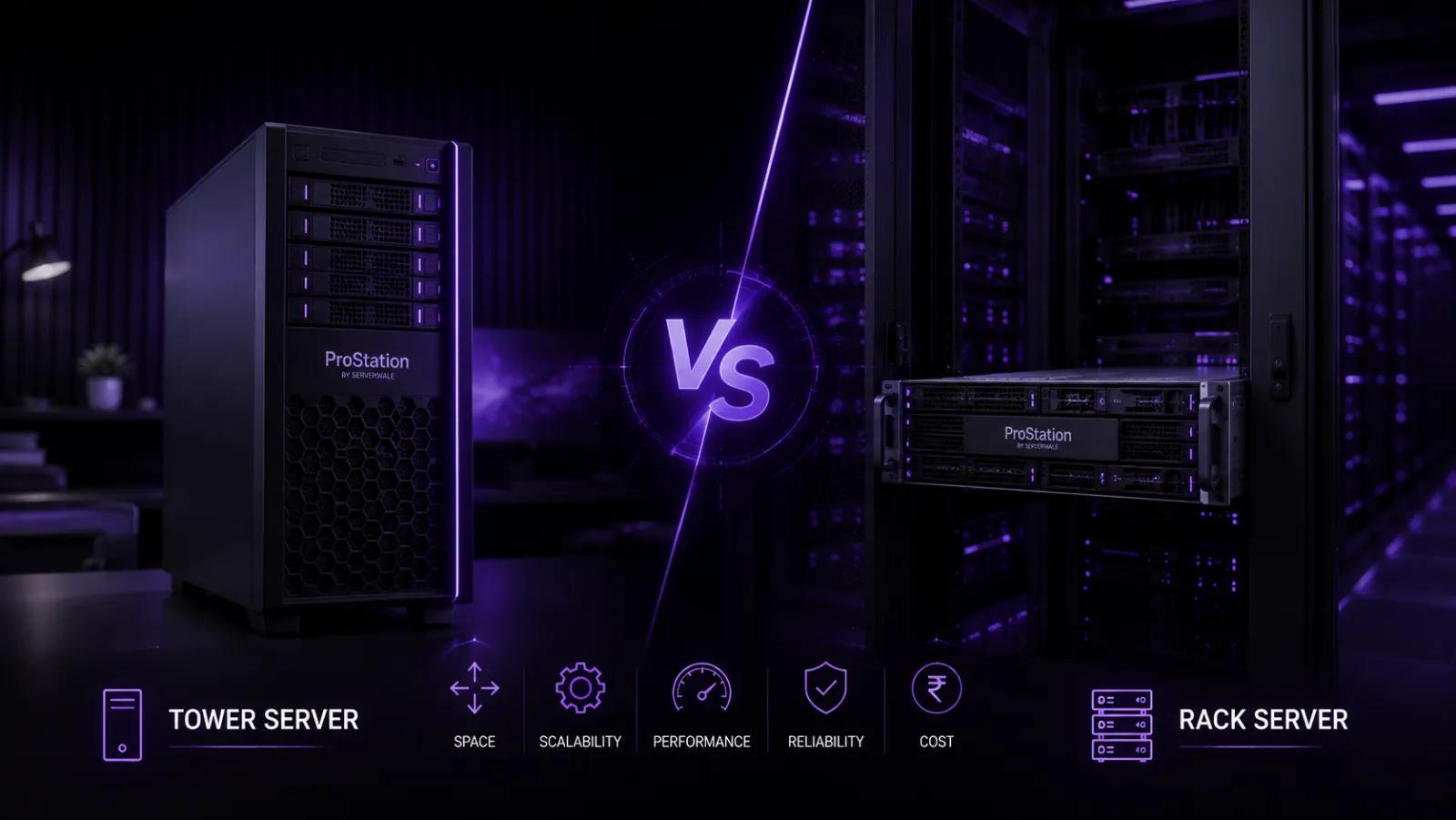
Buying a server for your business and stuck between a tower server and a rack server? Both can be built brand-new and custom-configured — the right choice comes down to where the machine will live, how many you'll run, and how you'll grow. This 2026 guide breaks down the difference for Indian buyers and helps you pick without overspending.
Whichever you choose, ProStation Systems builds both to order — assembled, tested and warranty-backed.
Tower vs rack: the quick answer
A tower server looks like a desktop PC and stands on the floor or under a desk. It's quiet, easy to place anywhere, and ideal when you run one or a few servers. A rack server is a flat chassis (1U/2U) that bolts into a 19-inch rack — built for density, when you run many machines together in a server room or data centre.
Side-by-side comparison
| Factor | Tower server | Rack server |
|---|---|---|
| Best when | 1–3 servers, office/SMB | Many servers, server room |
| Placement | Floor / under desk, no rack needed | 19" rack, organised cabling |
| Noise | Quieter — office-friendly | Louder — needs a server room |
| Density | Low (takes floor space) | High (many per rack) |
| Expandability | Lots of internal room for GPUs/drives | Limited by chassis height |
| Cooling | Easy airflow, big quiet fans | High-static-pressure rack airflow |
| Upfront cost | Often lower (no rack/PDU) | Higher once rack + infra counted |
When a tower server is the right call
Choose a tower when you're an SMB, a studio, a clinic or a startup running a handful of machines without a dedicated server room. Towers are quiet enough for an office, have plenty of internal space for big GPUs and many drives, and skip the cost of a rack, PDU and structured cabling. Most ProStation builds are custom tower servers for exactly this reason.
When a rack server makes sense
Go rack-mount when you're running many servers together, already have (or are building) a server room, and need organised density — for example a growing virtualization cluster or a multi-node deployment. Racks make cabling, power distribution and cooling manageable at scale, but they assume the surrounding infrastructure exists.
How to decide
- Running 1–3 servers, no server room → tower.
- Need big internal expansion (multi-GPU, many drives) → tower.
- Running many machines, have rack + cooling → rack.
- Tight floor space, planning to scale density → rack.
Not sure? It's worth deciding new vs refurbished at the same time — see new vs refurbished servers — and our team can help size either form factor.
Frequently Asked Questions
Is a tower server less powerful than a rack server?
No. Form factor doesn't limit performance — a tower can hold the same (or more) CPU, GPU, RAM and storage as a rack server. The difference is placement, density and noise, not power.
Can I put a tower server in a rack later?
Towers and rack servers are different chassis, so you can't convert one to the other. If you expect to move to a rack soon, build rack-mount from the start; otherwise a tower is simpler and cheaper.
Which is cheaper?
For a single machine, a tower is usually cheaper because you don't need a rack, PDU and structured cabling. At scale, rack servers are more efficient to run together.
Can ProStation build both?
Yes — we build brand-new custom tower and rack servers to your exact spec. Configure your build or contact us.
Get the right server built for you
Tell us your workload and where the machine will live, and we'll recommend tower or rack, spec it, build it new and back it with a warranty and support plan.
📞 +91-87968-22044 | Configure your build | Contact ProStation Systems